
"The Wi-Fi is slow" is one of the least useful pieces of diagnostic information in IT. It can mean congestion, coverage, interference, a saturated uplink, or a single misbehaving device. Replacing access points with newer ones fixes exactly one of those causes.
What 6E actually changes
Wi-Fi 6E extends Wi-Fi 6 into the 6 GHz band. The value is not raw speed — it is clean spectrum. The 2.4 GHz band is crowded and the 5 GHz band is increasingly so in dense buildings. 6 GHz gives you a large amount of interference-free channel width, which matters most exactly where the old bands struggle.
Signs the standard is your bottleneck
- High client density in a small area: meeting rooms, auditoriums, open-plan floors
- Neighbouring tenants saturating 5 GHz in a shared tower
- Heavy use of wireless screen sharing or video conferencing from laptops
- Modern client devices that already support 6 GHz
Signs it is not
If coverage drops out in the same corner every time, that is placement. If everything is slow at 9am and fine at 3pm, look at the internet uplink before the radios. If one department suffers and the rest do not, look at the switch they share. And if the access points are running on Cat5e delivering a gigabit uplink, a faster radio simply moves the queue one hop.
A Wi-Fi 6E access point on a gigabit uplink is a wider road that still ends at the same gate.
The cabling question nobody asks first
High-density 6E deployments want multi-gigabit uplinks and more PoE budget than earlier generations. That means Cat6A to the ceiling and switches that can actually deliver the power. Plenty of "Wi-Fi upgrades" turn out to be cabling and switching projects with new access points attached — which is fine, as long as it is budgeted that way from the start.
How we decide
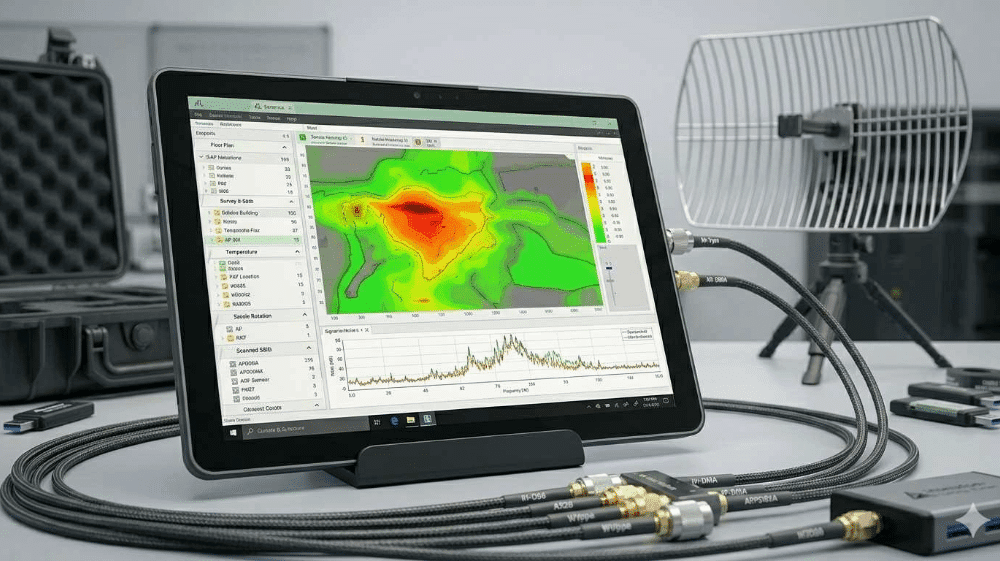
A predictive survey against the floor plan, then a validation survey on site with real measurements. That produces an access point count, mount positions, channel plan and PoE budget. If the survey says your existing estate is well-placed and simply congested, 6E is a genuine upgrade. If it says half your access points are in the wrong place, moving them costs far less than replacing them.
Related services